
The Science and Soul of Berres Brothers Strawberry Truffle Coffee
Let’s be honest for a second: there is a very specific, almost primal kind of magnetism that happens in a grocery store aisle when you spot that neon “Limited Time Offer” (LTO) sticker. It’s the culinary equivalent of a ticking clock. For most people, it’s a curiosity; for me, with my background as a former chef, it’s a professional siren song. My brain is essentially hardwired to seek out seasonality. In the high-pressure environment of a professional kitchen, seasonality is the heartbeat of the menu. It’s the frantic excitement of the first spring ramps appearing in a crate, or the earthy, soulful smell of winter’s deepest root vegetables being prepped for a slow roast. We live for those windows of time where an ingredient is at its absolute peak.
However, when you translate that “limited time” philosophy to the world of retail coffee roasters, things get… interesting. Usually, it means bold, experimental, and, let’s be real, sometimes highly polarizing flavor profiles. It is a true culinary tightrope walk. As a creator, you want the innovation to sparkle; you want to give the customer something they’ve never experienced before. But as a consumer, you definitely don’t want your morning caffeine fix to taste like a laboratory experiment gone horribly wrong.
Now, I’m going to share a secret with you right out of the gate, and it might make some of you gasp: I am not a “strawberry person.” I know, I know, it feels like a confession of some deep moral failing. But if there is a bowl of gorgeous mixed berries sitting on a brunch table, the strawberries are always, without fail, the very last to go for me. I find them frequently underwhelming, watery, or, worst of all, deceptively tart. My palate just doesn’t naturally gravitate toward that specific berry profile.
So, why on earth did I find myself staring at a bag of Berres Brothers Strawberry Truffle coffee? It was that second word: Truffle. In the culinary lexicon, “truffle” (when referring to the confection, not the fungus) implies a rounded, fatty richness. It suggests a velvety chocolate ganache that coats the tongue. I couldn’t help but wonder: could that promised richness actually tame the wild, unpredictable tartness of the fruit? Could a coffee roaster actually bridge the gap between the bright, acidic zing of a berry and the deep, roasted soul of a high-quality coffee bean?
We’ve all experienced the dreaded “aroma vs. reality” gap with flavored coffees. You know the one, where the bag smells like a magical Willy Wonka factory, but the actual brewed cup tastes like burnt toast with a weird, lingering chemical finish that makes you regret your life choices. It’s the ultimate betrayal. But I’ve always had a massive amount of respect for Berres Brothers; they usually have a remarkably steady hand with their infusions. So, fueled by a mix of professional curiosity and a lingering hope that I might finally find a strawberry experience I actually enjoyed, I dropped the bag into my cart. I wanted to see if this LTO could win over a stubborn skeptic or if it would simply reinforce my decades-long strawberry-shunning ways.
The First Look: Appearance and Aroma
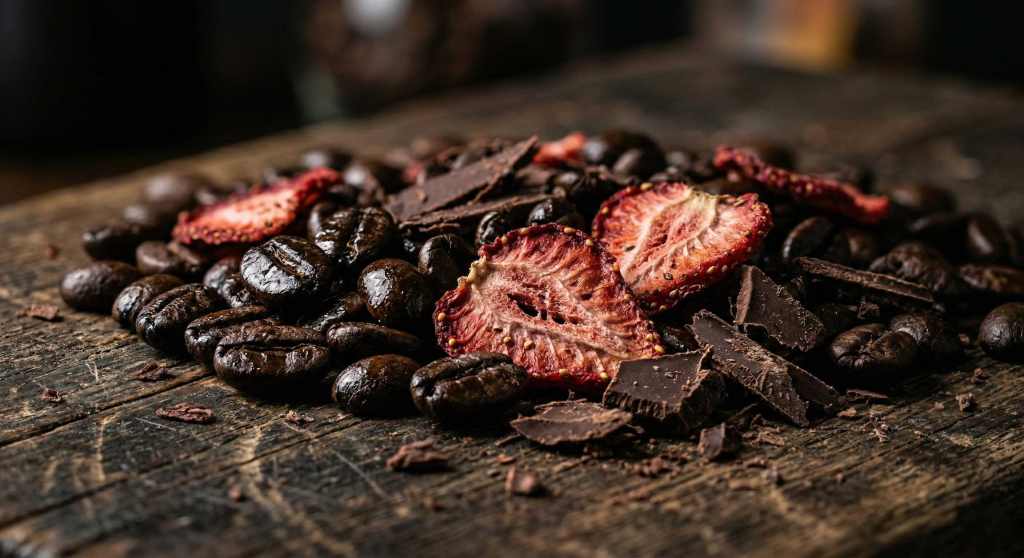
In the culinary world, we say you eat with your eyes first, and coffee is no different. The moment of truth actually happens long before the water hits the grounds. When I tore open the packet, I wasn’t just looking for a smell; I was looking for the “mise en place” of the bean itself. I was immediately struck by the gorgeous visual quality of the roast.
This wasn’t some dusty, light brown, “value-tier” blend hiding behind a curtain of artificial oils. These beans had a rich, dark, oily sheen that caught the light perfectly. To the untrained eye, it’s just shiny coffee; to a chef, it’s a signal. That sheen tells me the Maillard reaction, that magical chemical reaction between amino acids and reducing sugars that gives browned food its distinctive flavor, was handled with absolute care during the roasting process. It looked substantial, like it had enough structural integrity to support whatever flavor was about to be layered on top of it.
Then came the scent. Initially, the aroma was a shy, delicate floral note. It was subtle, reminiscent of a garden after a light rain, rather than the aggressive, synthetic candy store smell I had been dreading. It felt natural, not forced. But the real magic, the “showtime” moment, happened when the hot water finally saturated the grounds. Suddenly, the steam carried a transformation. My kitchen was filled with this incredible “warm fruit” aroma. It didn’t just smell like berries; it smelled exactly like a fresh strawberry tart coming right out of the oven, where the heat has concentrated the sugars and the pastry is just beginning to toast. It was inviting enough to make me forget, for a few minutes at least, my usual berry prejudices.
Flavor Profile and Nuance: The Chef’s Breakdown
When we evaluate a dish or a drink professionally, we break it down into three distinct phases: the entry, the mid-palate, and the finish. It’s about how the story of the flavor unfolds from the second it touches your tongue to the moment after you swallow.
- The Entry: The strawberry flavor here is remarkably controlled. It’s mild, which is a massive win in the world of flavored coffees. Often, fruit flavors are dialed up to eleven, but here, it provides a sophisticated pop of “fruity acid” on the sides of the tongue. It mimics the natural tang of a peak-season berry without that sharp, metallic “sour bite” you get from under-ripe fruit. It’s a bright, cheerful introduction.
- The Mid-Palate: Hello, truffle! This is where the engineering of the flavor really shines. As the liquid moves across the center of your tongue, a perceived sweetness steps in to round out the coffee’s natural bitterness. This is that “truffle” influence, it creates a gorgeously smooth, almost velvety mouthfeel. It provides the “fat” (at least in a sensory sense) that balances the acidity of the entry.
- The Finish: The finish is undeniably indulgent. It leans into a clean, dessert-like profile with zero chemical aftertaste. This is where most flavored coffees fail, leaving a film or a strange artificial tang. This, however, leaves you with the lingering memory of a rich confection. The roasted coffee beans act as a sturdy “bass note” to the strawberry’s “treble,” ensuring the experience never feels flimsy or shallow.
Behind the Technique: Why It Actually Works
From a purely technical standpoint, creating this blend is a bit of a nightmare. Why? Because strawberries are naturally high in malic and citric acid. Coffee, too, has its own incredibly complex acidic structure. If you simply layer a high-acid fruit flavor over a high-acid coffee bean, you end up with something that tastes like battery acid, sharp, thin, and unpleasant.
Berres Brothers dodged this bullet with some clever culinary logic. By using a darker, richer roast as the base, they provided enough “roastiness” and body to absorb the strawberry notes. It’s the exact same principle we use in a professional kitchen when we pair a tart fruit with a dark chocolate or a heavy cream. You need those deep, “heavy” flavors to provide a stable landing pad for the bright, fruity highlights. Without that dark roast base, the strawberry would just float on top, disconnected and shrill. Instead, it feels integrated, as if the flavor was grown into the bean rather than sprayed onto it.
The Final Verdict: 4.2 / 5 Stars
This is a highly sophisticated, indulgent LTO that treats the strawberry with the respect it deserves. It is a masterclass in balance, proving that even a “limited time” offering can be executed with professional-level precision.
Did it magically cure my lifelong prejudice against strawberries? Not quite. If you offered me a bowl of them tomorrow, I’d still reach for the blueberries first. Because of that, this coffee probably won’t find a permanent, everyday home in my pantry. However, it definitely earned my deep respect. As I often say on this blog, finding great food and drink experiences isn’t always about finding things you want to consume every single day.
Sometimes, it’s about the appreciation of the craft. It’s about recognizing when someone has taken a difficult set of ingredients and turned them into something harmonious.
I enjoyed the ride, I respected the technique, and I’m genuinely glad I took this foray into the strawberry landscape. It reminded me that even as a former chef with a set-in-stone palate, I can still be surprised, and that is exactly why I keep hunting for new things to enjoy.
Who should try this?
- The Dessert Lovers: Anyone who loves a “dessert in a cup” experience without the dreaded sugar crash.
- The Explorers: Fans of unique, seasonal flavors who appreciate a subtle, nuanced touch rather than a flavor sledgehammer.
- The Morning Optimists: Anyone looking to brighten up a gray morning with a bit of floral, fruity energy.
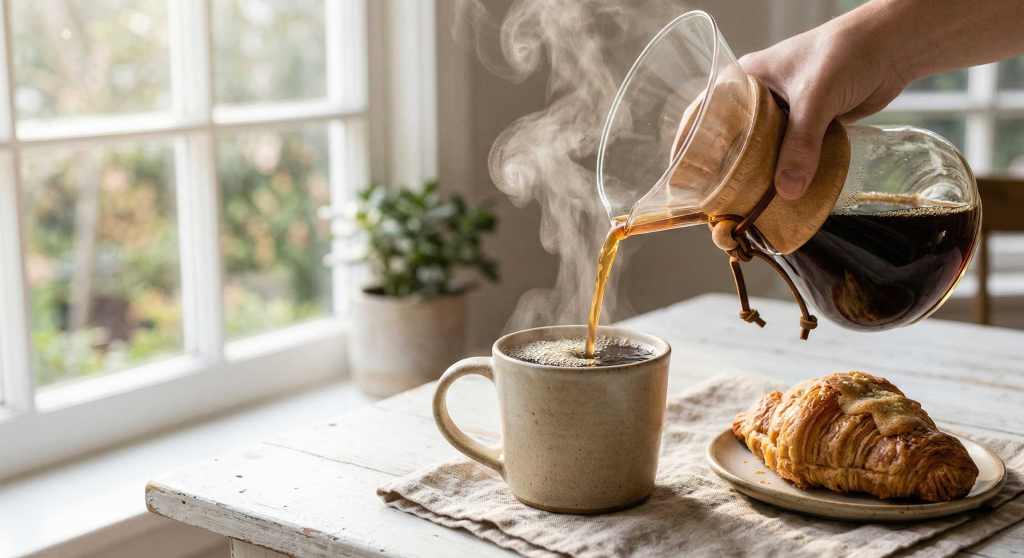
Chef’s Pairing Tip: If you want to take this to the next level, serve it alongside a buttery piece of shortbread or a plain, flaky croissant. You want something neutral and rich in butterfat to let that “truffle” flavor really sing. Avoid anything too sweet, or you’ll lose the subtle nuances of the coffee itself.
What about you? Are there any flavors or ingredients out there that you absolutely respect from a technical standpoint, but they just aren’t “for you”? Or have you found a limited-edition coffee lately that totally changed the way you look at your morning routine?
Let’s chat in the comments, I’m curious to see who else is a fellow skeptic!
 Things I Enjoy