
The Quest for the Perfect Square-Cut Slice
If you’ve been following my recent deep dives into the world of artisanal coffee, you know I’m a sucker for complexity. I love a bean that tells a story of high altitudes and meticulous roasting. But today, we’re putting down the Chemex and heading straight for the freezer aisle. It’s time for a change of pace. We’re talking about the holy grail of Midwestern comfort food: Chicago Style Thin Crust pizza.
Now, before my friends in New York start drafting a rebuttal, let’s clear something up. When most people think of Chicago, they think of Deep Dish, that monolithic casserole of cheese and sauce that requires a nap and a lifestyle change after one slice. But for those of us who grew up in/near the Windy City, the true local legend is the “Tavern Style.” It’s thin, it’s crispy, it’s heavily seasoned, and most importantly, it is always, always cut into squares.
I’ve spent a good portion of my life in professional kitchens, and if there’s one thing a chef’s background gives you, it’s a blessing and a curse: you can never just “eat.” You analyze. You deconstruct. You look at a plate and see the technique, the ingredient sourcing, and the shortcuts taken (or avoided). I grew up with the smell of cornmeal-dusted crusts and fennel-heavy sausage from the local neighborhood spot. As a result, I’ve developed a bit of a “harsh judge” reputation. This happens when it comes to anyone claiming they’ve mastered the Chicago thin style, especially in the frozen section.
The frozen pizza aisle is a minefield of disappointment. We’ve all experienced it. We get seduced by the high-gloss photography on the box. Then, we pull out a soggy, flavorless disc. It tastes more like the cardboard it sat on than actual fermented dough. Yet, the search continues. It’s a hobby of mine, a culinary “thing I enjoy,” finding those rare gems that actually deliver on their promises.
So, there I was, winding my way through the fluorescent-lit aisles, when a box caught my eye: Nancy’s Chicago Style Thin Crust Italian Sausage. Nancy’s is a legendary name in the pizza world, credited by many with inventing the stuffed pizza. But here they were, pivoting to the Tavern Style. The picture on the box was the hook; it showed that iconic, beautiful square cut. Hope is a dangerous thing in the frozen food aisle, but I felt a glimmer of it. Fingers crossed, I added it to my cart, finished my shopping, and headed home to see if Nancy’s could live up to the heritage.

The First Look: Anatomy of an Unbaked Pie
As a former chef, my review starts the moment the plastic wrap comes off. I’m looking for indicators of quality before the heat even hits the oven.
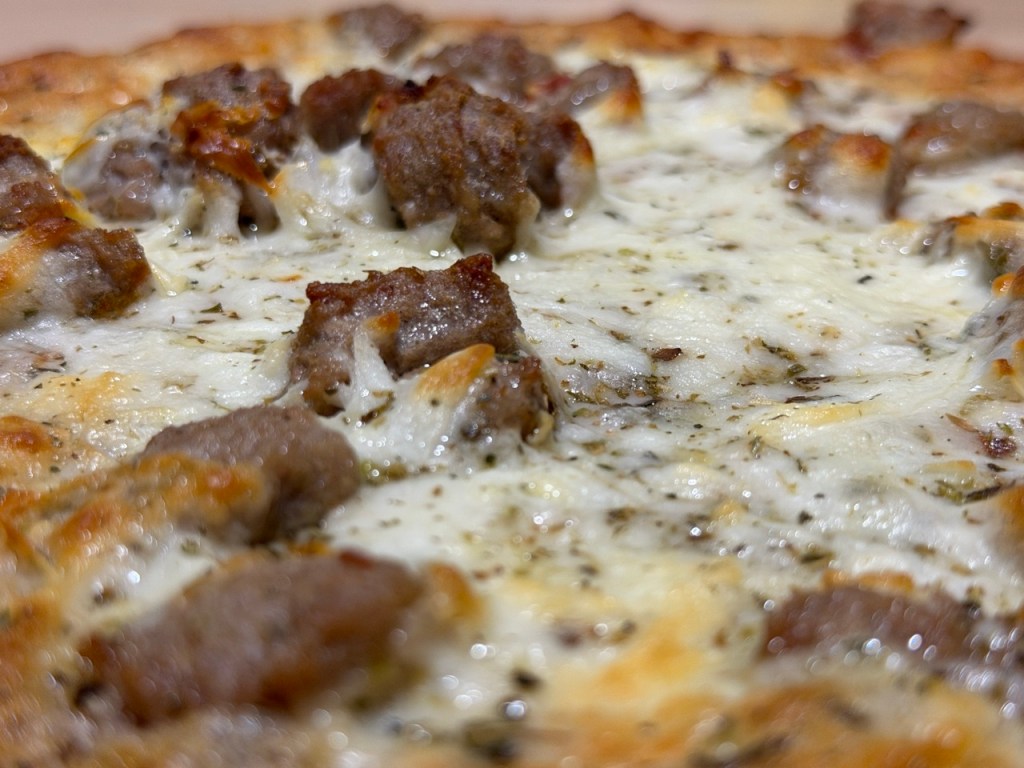
At first glance, Nancy’s looked incredibly promising. The distribution of ingredients was top-notch. One of my biggest gripes with mass-produced frozen pizza is the “clump factor”, where all the meat is huddled in the center, and the cheese is non-existent at the edges. This wasn’t the case here. The cheese was ample and reached almost to the very perimeter, and I was genuinely impressed by the sausage. Instead of the over-processed, gray “meat paste” pellets some brands use; these were decent-sized, irregular chunks. They looked like an actual hand-pinched sausage.
There was a visible sprinkling of seasoning over the cheese. It was likely a blend of oregano and garlic. There may also have been a touch of dried basil. It’s a small detail, but it speaks to a desire to provide a finished flavor profile rather than just raw components.
However, the professional in me spotted a red flag the moment I flipped the pizza over: dock marks. For those unfamiliar with the term, “docking” involves piercing the dough with small holes to prevent it from bubbling up too much in the oven. In the world of thin crust, this is common, but it often signals a “dead” dough. In a bakery or a high-end pizzeria, you want the crust to develop flavor through a slow proofing process where yeast consumes sugars and creates complex aromatic compounds. When you see heavy docking on a pre-made crust, it usually means the dough was formulated for consistency and shelf-life rather than flavor development. It suggested a crust that might be more “cracker” than “bread.” I kept my expectations guarded as I slid it onto the center rack.
The Bake and the Aroma: Building Anticipation
The instructions gave a standard window, but my oven (and my preference for a well-done “leopard” spotting on the cheese) required an extra five minutes. You want that Maillard reaction to really take hold, that chemical reaction between amino acids and reducing sugars that gives browned food its distinctive, savory flavor.
As it baked, the kitchen began to fill with a very nostalgic aroma. The scent of the Italian sausage was front and center, heavy on the fennel and garlic, which is exactly what you want from a Chicago pie. There was a subtle sweetness from the tomato sauce and the herbal hit from that pre-sprinkled seasoning.
When I finally pulled it out, the crust was undeniably crispy. It had that rigid, structural integrity that defines Tavern Style. The cheese had what I call the “typical frozen cheese aspect.” It doesn’t quite emulsify with the sauce; instead, it sort of floats in a singular, melted sheet on top. It’s not a deal-breaker, but it lacks the “pull” and the gooey integration you get with fresh mozzarella or a high-quality provolone blend. Still, it looked golden, bubbling, and ready for the pizza cutter.

Flavor Profile and Nuance: The Good, The Bad, and The Bland
Let’s get into the heart of the matter: the taste.
- The Sausage: This was the standout performer. It had a lovely “zing” to it, a hint of herbs and a slight sweetness that balanced the saltiness of the pork. It felt substantial in the mouth, providing a meaty contrast to the thin base.
- The Sauce: The sauce did exactly what it needed to do. It tasted like actual tomatoes, not a sugar-laden ketchup substitute. It had enough acidity to cut through the fat of the cheese and sausage, providing a bright mid-palate note.
- The Cheese: While the flavor was good, salty, creamy, and satisfying, the texture was a bit one-dimensional. As I suspected during the bake, there was zero “pull.” It’s a functional cheese; it provides the necessary richness, but it won’t win any awards for mouthfeel.
The Disappointment: The Crust. Here is where my “harsh judge” side has to speak up. Despite the great toppings, the crust was a letdown. A true Chicago thin crust should have a “bready” soul, it should be thin and crisp, yes, but it should still have a fermented flavor and a slight chew.
Nancy’s crust, as I feared when I saw those dock marks, was bland and dry. It felt very “cracker-like,” almost like a large, unsalted Matzo cracker. There was no depth of flavor in the grain, no hint of yeast or slow-rise complexity. It served as a crunchy vessel for the toppings, but it didn’t contribute anything to the overall culinary experience. For a pizza that brands itself on “Chicago Style,” the foundation, the dough, just didn’t hit the mark.
The Final Verdict: A Reliable Pinch-Hitter
So, where does that leave us? As a former chef, I look for balance and soul in food. While the toppings on Nancy’s Chicago Style Thin Crust have plenty of soul, the crust is a bit soulless. It’s a shame, because if this were paired with a high-quality, cold-fermented dough, it would be a world-class frozen pizza.
Final Rating: 6.5 / 10
Who is this for?
Even though it won’t be a permanent resident in my freezer, I can still recommend it. Why? Because the price point is fair, and the toppings are genuinely better than 80% of what you’ll find in the frozen aisle.
- The Hungry Teenager: This is the perfect “after-school” pizza. It’s sturdy, flavorful, and easy to eat.
- The Late-Night Craving: If it’s 11:00 PM and you want something salty and crunchy while watching a movie, this hits the spot perfectly.
- The Crowd Pleaser: If you’re hosting a casual hang and need to put out some appetizers, square-cut this pizza and it will disappear in minutes.
Best Served With…
To elevate the experience, I’d suggest a side of spicy giardiniera (a Chicago staple) to add some heat and acid, or perhaps a very cold, crisp Pilsner to play off the saltiness of the sausage.
Closing Reflections
At the end of the day, my search for the “perfect” frozen Chicago thin crust continues. This experience reminded me that even in the world of convenience food, the fundamentals of cooking, like dough fermentation and hydration, matter immensely. You can’t hide a mediocre base under good toppings, at least not from a chef’s palate.
But that’s the joy of the journey, isn’t it? The “things I enjoy” aren’t just the perfect meals; they’re the process of discovery, the “almost-theres,” and the stories we tell along the way. Nancy’s gave me a nostalgic evening and a decent snack, and sometimes, that’s enough to keep the search alive.
What about you? Is there a frozen pizza brand you swear by that actually gets the crust, right? Or are you a “crust-as-a-cracker” defender? Let’s settle the Chicago thin crust debate in the comments!
 Things I Enjoy